
- Before signing the Cuban trade embargo in 1962, President Kennedy sent his press secretary out to secure 1,200 H. Upmann petite coronas, he signed only after the cigars were safely in hand.
- Cigar Aficionado launched in September 1992 with a target of 20,000 readers; the first issue reached over 100,000 and triggered one of the fastest consumer product growth curves in American history, driving US premium cigar imports from 100 million to 400 million units in five years.
- Nicaragua shipped over 123 million handmade cigars to the United States in the first half of 2025 alone, nearly two-thirds of all US premium cigar imports, while Habanos S.A. set a global revenue record of $827 million in 2024.
I have a confession to make. The first five cigars I ever smoked left me green. I mean genuinely, embarrassingly green. They were passed around at parties, handed to me by friends who seemed to know what they were doing, and I smoked them with the confidence of someone who had no business holding one. But somewhere in there, something shifted. I kept at it, partly out of stubbornness, partly because I was lucky enough to have a receptionist whose boyfriend happened to distribute Cuban cigars. He would bring me the odd case, and eventually I found myself holding a Cohiba and understanding, maybe for the first time, what the whole thing was about.
My commute to work was an hour each way. Five days a week, I smoked in the car. One car, one cigar, one hour. My wife eventually put her foot down on the new car. The cigars were out. The pipe, however, she has always maintained that pipe tobacco smells like air freshener, and I have never been in any hurry to correct her. But that Cuban cigar changed how I thought about all of it. My friends noticed. They still call me when they want to know what to smoke. This chapter is about why that conversation is even possible today, because what happened in the forty years after 1982 was not inevitable. It was earned.
JFK's last order
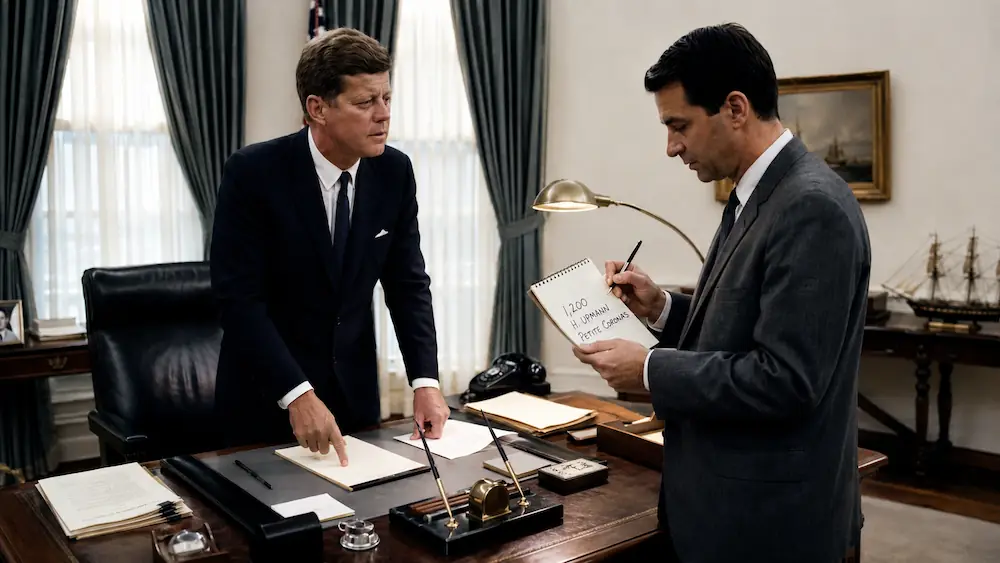 AI-generated image
Before the story of the modern cigar begins, there is one scene from 1962 that deserves its own moment. On the night of February 6, 1962, the eve of the United States officially imposing a full trade embargo on Cuba, President John F. Kennedy called his press secretary Pierre Salinger into the Oval Office and gave him a specific assignment. He needed 1,200 H. Upmann petite coronas. By morning.
Salinger went to work. He returned the next day with 1,201 cigars. Kennedy was satisfied. He opened his desk, produced the embargo order, and signed it. The most consequential act of trade policy in the history of the cigar industry was deliberately delayed until the President had secured his personal supply. Kennedy, as it turned out, was a committed cigar smoker who understood exactly what he was about to give up, and was not about to give it up before he had to. That story has been told in Washington for sixty years, and it is as good a summary of America's complicated relationship with the Cuban cigar as any historian has managed to produce.
Cohiba steps into the light
 AI-generated image
 AI-generated image
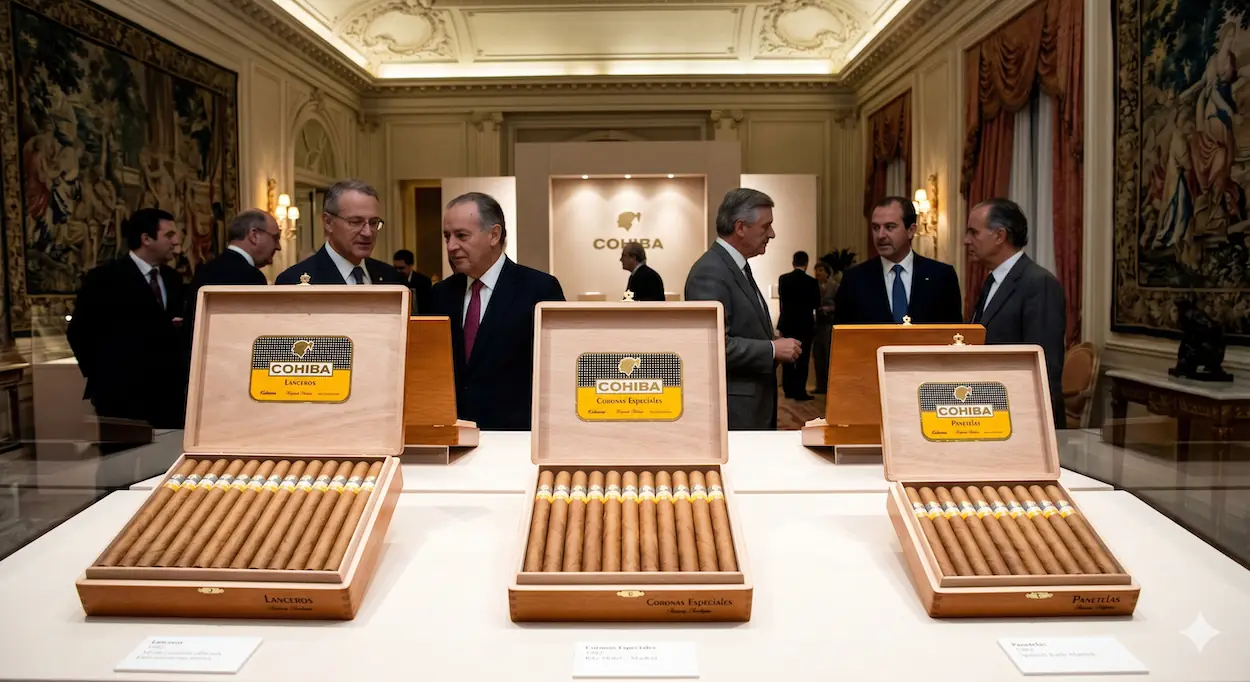
When Cohiba was officially released for commercial sale in 1982, the world was introduced to it in the most restrained way imaginable. Three vitolas were made available: the Lanceros, the Coronas Especiales, and the Panetelas, all elegant, all spare, all bearing the now-iconic yellow and black band with white dots that had previously been seen only in the hands of diplomats and foreign dignitaries. The cigars were not advertised. They did not need to be. Their reputation had preceded them by fifteen years.
The brand grew methodically. In 1989, three new vitolas, the Espléndidos, the Robustos, and the Exquisitos, were added, completing what became known as the Línea Clásica, the Classic Line. Then in 1992, to mark the five hundredth anniversary of Columbus's arrival in the Caribbean, Habanos launched the Línea 1492, the Siglo range, five vitolas named Siglo I through Siglo V. The Siglo VI followed in 2002. In 2007, the Maduro 5 line was introduced using wrappers aged for a minimum of five years. In 2010, the Cohiba Behike arrived: the most exclusive line in the brand's history, incorporating the rare medio tiempo leaf, a third leaf from the very top of the tobacco plant, found only on a small percentage of individual plants, for a depth of flavor that places it in a category of its own. No other Habanos brand uses medio tiempo. Cohiba uses three fermentations in wooden barrels for its seco, ligero, and medio tiempo leaves, a process found nowhere else in cigar production.
Zino Davidoff draws a line
In August 1989, Zino Davidoff did something that had never been done in the premium cigar world before and has never been done since. He stood in front of representatives from Cuba's state tobacco organization Cubatabaco and Swiss customs officials, and he lit a fire. Into it went over 130,000 Cuban-made Davidoff cigars that he had deemed unacceptable, below the quality standard his customers expected and his brand represented. He did not request a refund. He did not negotiate. He burned them.
The backstory is worth knowing. Davidoff, born in Kiev in 1906, the son of a tobacco merchant, who moved to Geneva as a child and spent his life building one of the world's great tobacco houses, had licensed his name to Cubatabaco in 1967 and seen the first Davidoff-branded Cuban cigars roll out of El Laguito in 1968. For more than twenty years, the relationship was productive. But as the 1980s progressed, Davidoff became increasingly dissatisfied with the quality and consistency of what he was receiving from Havana. He complained. The complaints were not addressed. In 1989, he reached his limit.
By 1990, Davidoff had relocated production to the Dominican Republic, partnering with master blender Hendrik Kelner. The first Dominican-made Davidoff cigars launched in 1991. Zino Davidoff died in Geneva in 1994 at eighty-seven, knowing what he had built in the Dominican Republic had already proven his point, that a non-Cuban cigar, made with the right leaf and the right hands, could command the highest prices and deepest respect in the world market. The Cuban Davidoffs he burned are now collector's items.
A magazine changes everything
 AI-generated image
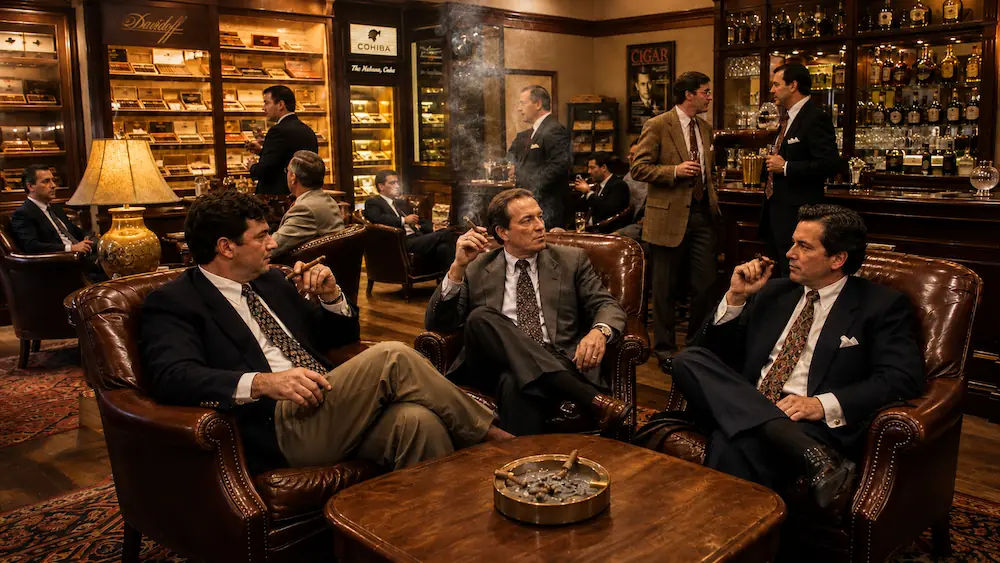
In fall of 1992, an idea that many in the industry called crazy arrived on newsstands. The first issue of Cigar Aficionado hit stands in September 1992. Marvin R. Shanken, who had first coined the phrase "cigar aficionado" in a Wine Spectator column in 1984, aimed for a first-run circulation of 20,000. The first issue reached over 100,000 readers and turned a profit in year one. That almost never happens in magazine publishing.
What Shanken understood was that the cigar was ready to be positioned the way fine wine had been, as a sophisticated, aspirational pleasure with a vocabulary, a scoring system, a culture, and a consumer base willing to pay for quality. The effect was almost immediate. In 1993, premium cigar imports into the United States rose ten percent to more than 117 million units. By 1997, the US was importing over 400 million premium cigars annually, one of the fastest consumer product growth curves recorded in American commercial history. Walk-in humidor rooms appeared in restaurants. Cigar bars opened in cities that had never had them. Arnold Schwarzenegger held cabinet meetings in a smoking tent outside the California governor's office. Michael Jordan, Rush Limbaugh, and Jack Nicholson appeared on Cigar Aficionado covers.
The demand so far outpaced supply that manufacturers rushed under-fermented product to market. The quality of many mid-tier brands collapsed. In 1997, the boom crashed under the weight of its own excess. But what remained after 1997 was better than what existed before 1992, the serious brands, the serious makers, and a consumer base that had learned to distinguish quality from volume. The standard had permanently moved upward.
The families who rebuilt the world
The story of the modern premium cigar cannot be told without the story of the people who built it, and most of those people had lost everything once before.
Arturo Fuente Sr. had left Cuba and built his first factory in West Tampa in 1912, employing more than 500 people. In 1924, a fire burned it to the ground. His son Carlos bought the business from him in 1958 for one dollar. When the Cuban Revolution scattered the industry, Carlos lost factories in Nicaragua to the Sandinista Revolution and survived multiple catastrophic fires. Carlos and his son Carlito moved to Santiago in the Dominican Republic in 1980. At the time, the Dominican Republic was not considered capable of growing world-class wrapper leaf. Carlito Fuente did not accept that. He established Chateau de la Fuente, a farm carved out of Dominican jungle, and in 1995 released the Fuente Fuente OpusX: the first cigar ever made entirely of Dominican tobacco, including the wrapper. Cigar Aficionado named it one of the top cigars in the world. The waiting lists were immediate and in some cases lasted years.
The Padrón story is equally extraordinary. José Orlando Padrón was born in Cuba in 1926, grew up on his family's tobacco farm in Pinar del Río, and fled to Miami in 1962 after Castro nationalized everything. The Cuban government gave him $60 a month in refugee aid. A friend handed him a carpenter's hammer. He worked carpentry by day and rolled cigars at night. With $600 saved, he founded Piloto Cigars Inc., later known as Padrón Cigars, in Miami on September 8, 1964, with a single roller producing 200 cigars a day. In March 1967, a Nicaraguan tobacco agent brought samples from the Estelí valley. Padrón recognized the soil and microclimate matched Pinar del Río almost exactly, flew to Nicaragua, and moved his entire operation to Estelí by 1970. He survived civil war, factory fires, and a brief US embargo on Nicaraguan goods. José Orlando Padrón passed away in December 2017 at ninety-one. The small hammer, El Martillito, that earned the $600 that started everything is still depicted on the Padrón Family Reserve label.
The boutique revolution
By the early 2000s, a new generation of cigar makers had arrived, people who cared more about sourcing extraordinary leaf than about volume. Jonathan Drew opened a cigar kiosk in the World Trade Center in 1995 to fund his law school studies. The kiosk did over $500,000 in sales in its first year. Drew abandoned law school, founded Drew Estate in 1996, and eventually built a factory in Estelí. In 2007 he released Liga Privada, a blend using tobacco from Honduras, Nicaragua, Brazil, and the United States with a Connecticut broadleaf wrapper so distinctive it became a cult obsession almost immediately. Liga Privada No. 9 and T52 became two of the most talked-about cigars of the modern era.
Cigar smokers started talking about Nicaraguan ligero from Jalapa the way wine enthusiasts discuss single-vineyard Burgundy. New brands like Warped, Crowned Heads, Southern Draw, and Room101 built devoted followings with small batches, distinctive aesthetics, and unusual blending choices. Instagram gave boutique brands a direct line to consumers that had never existed before.
The rise of Nicaragua
Through all of this, Nicaragua was quietly rewriting the geography of premium cigar production. The country shipped only 16 million premium cigars to the United States in 1996. By 2011, it was shipping over 102 million and closing in on the Dominican Republic as the top source. By the mid-2010s, Nicaragua had taken the top position and has never surrendered it. In the first half of 2025 alone, Nicaragua shipped more than 123 million handmade cigars to the United States, nearly two-thirds of all US premium cigar imports.
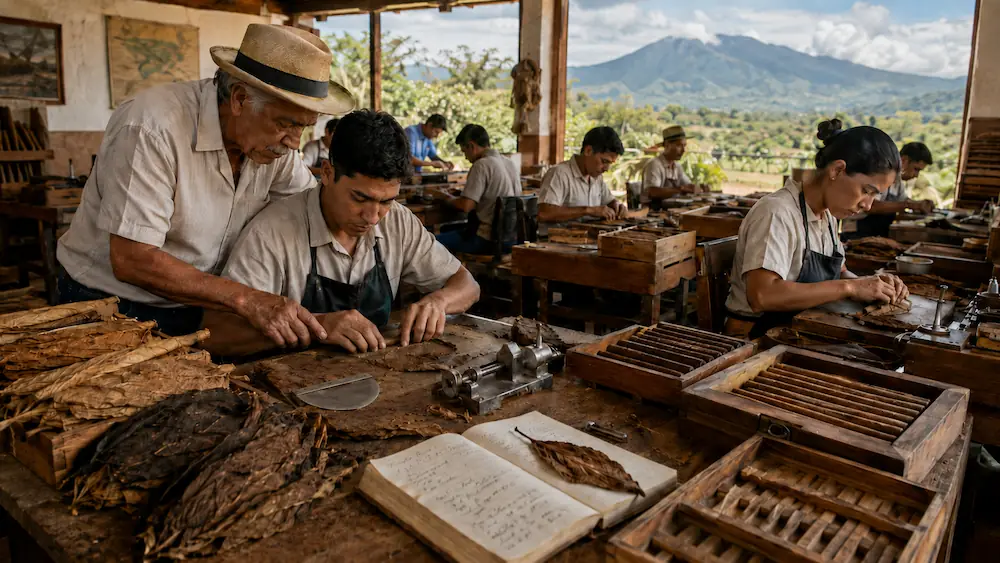
The volcanic soils of the Jalapa, Estelí, and Condega valleys produce tobacco with a complexity that is genuinely distinctive. My Father Cigars, founded by Cuban exile José Pepín García and his son Jaime, moved from Miami to Estelí and became one of the most respected premium operations in the world. Oliva Cigar Company, founded in Cuba's Pinar del Río in 1886 and later reestablished in Nicaragua by the Oliva family descendants, became the country's largest family-owned cigar producer. Ecuador entered the story as a world-class source of shade-grown wrapper leaf, Connecticut-seed tobacco grown in Ecuadorian valleys producing a wrapper many regard as more consistent than Connecticut itself.
The regulatory war
Beginning in 2011, the premium cigar industry found itself in an extended conflict with the US Food and Drug Administration. In 2016, the FDA's final deeming rule extended regulatory authority to all tobacco products including premium handmade cigars. The Premium Cigar Association and Cigar Rights of America filed suit immediately. In April 2019, Senator Marco Rubio convened the first-ever congressional hearing focused exclusively on premium cigar regulation.
In August 2023, the US District Court for the District of Columbia vacated the FDA deeming rule as applied to premium cigars, defining them as whole-leaf wrapped, handmade, long-filler, additive-free, and retailing above $10. The US Court of Appeals largely affirmed that decision in January 2025. After fourteen years, the industry had won what amounted to a permanent exemption from the framework that had threatened its existence.
The pandemic cigar boom nobody expected
When COVID-19 arrived in March 2020 and locked down much of the world, something unexpected happened in the cigar industry. Sales went up. Dramatically. People stuck at home, cut off from restaurants, bars, and travel, discovered or rediscovered the pleasure of sitting outside with a quality cigar. The ritual of preparing, lighting, and slowly smoking a premium cigar was exactly the kind of deliberate, patient pleasure that a pandemic made time for.
The numbers at the top of the market reflected the shift. Habanos S.A. reported record sales of $721 million in 2023, a thirty-one percent jump over the prior year. In 2024, that record was broken again: $827 million in global Habanos revenue, driven largely by surging demand from China, where an emerging class of affluent consumers had adopted the Cuban cigar as the ultimate status object. China was the top market by sales value, followed by Spain, Switzerland, the United Kingdom, and Germany. The second cigar boom was quieter than the 1990s explosion, but in terms of sustained revenue growth and the quality of what was being produced, it was more significant.
The ring gauge question
One of the most visible debates of the modern era is what has happened to the physical size of cigars. Traditional Cuban formats were built around ring gauges in the high 40s and low 50s. That standard began shifting in the early 2000s and has not stopped. The reasons are not purely cosmetic, a larger ring gauge accommodates more filler leaf, producing greater blend complexity and a cooler, slower burn. The 58-ring became standard. Then the 60. Then the 64. The JFR line from My Father Cigars pushed the concept explicitly, their Lunatic format reaches ten inches in length at 100 ring gauge, exactly one inch in diameter.
The ring gauge debate divides the cigar world fairly neatly. Traditionalists argue that the classic formats, Lancero, Lonsdale, Panetela, Churchill, represent the ideal expression of a master blender's work. The modern camp argues that the larger ring gauge, done well, produces a complexity and richness impossible in smaller formats. Both camps are right about their own preferences. The fact that the argument is still going is probably the most cigar thing about it.
Twelve thousand years from a bundle of tobacco tied with palm fiber to a $827 million global industry, the cigar survived wars, machines, depression, revolution, and regulators. Every cigar you have ever lit has all of that history behind it. The smoke still rises. It always has.
Glossary
Frequently asked questions