
- Human tobacco use now dates back approximately 12,300 years, burned wild tobacco seeds found in Utah are the earliest confirmed evidence on record.
- The Maya depicted gods, kings, and shamans smoking in codices and stone carvings dating to at least the 10th century; tobacco was ceremony, not leisure.
- The Taino people of Cuba and the Caribbean had a 2,000-year tobacco culture before Columbus arrived, their words tobak and Sik'ar gave the world "tobacco" and "cigar."
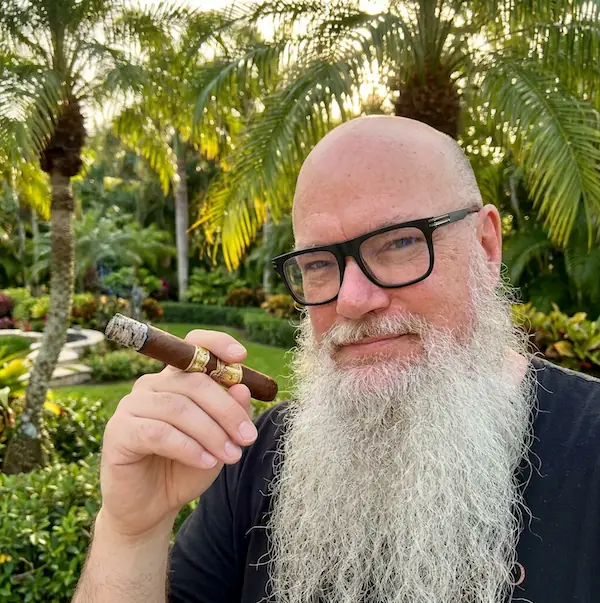
When I first started smoking cigars, I just smoked. That was enough. But somewhere along the way, that changed. I started looking at what was in my hand differently, the construction, the wrapper, the way it burned, and it hit me that what I was holding was not just a smoke. It was the result of years of cultivation, expertise, and craft passed down through generations. Once you start thinking that way, you cannot stop. You start asking questions. How far back does this go? Who was the first person to roll a leaf and light it? When did the cigar become what it is today? I went looking for answers, and what I found genuinely surprised me. The history of the cigar does not start in Havana. It does not start with Columbus. It starts in ancient civilizations that understood tobacco in ways most of us have never considered, and the story is far richer than anything you will find on the back of a band.
A history written in stone
Long before the cigar became a symbol of leisure, it was something far more serious. To the indigenous peoples of Mesoamerica and the Caribbean, tobacco smoke was not a pleasure, it was a prayer. It rose from the hands of priests, from the lips of chiefs, from the center of ceremonies that marked everything from healing to war to the striking of peace between rival groups. The cigar, in its earliest form, was not a luxury. It was a lifeline to the gods.
The story begins well before written records. In 2021, researchers published findings from the Wishbone site in Utah's Great Salt Lake Desert where burned wild tobacco seeds were found alongside ancient fire pits, pushing confirmed human tobacco use back to approximately 12,300 years ago. That is not a typo. Twelve thousand years. Long before any civilization we have a name for, people in the Americas were already in a relationship with this plant.
By the time the Maya were building their great cities across what is now Mexico, Guatemala, and Belize, tobacco had been woven into the fabric of spiritual and daily life for millennia. The evidence is carved into stone, painted on pottery, and written into the few Mayan codices that survived the Spanish conquest. The Madrid Codex, one of only four surviving Mayan books, contains multiple images of deities and figures smoking, presented not as recreation but as ceremony. At the ancient city of Palenque in present-day Chiapas, Mexico, a stone relief depicts the God L, one of the most powerful figures in the Mayan pantheon, associated with the underworld, trade, and war, with a lit cigar in hand. He is not relaxing. He is conducting the business of the gods.
Ceramic art from the late Classic Maya period, dated between 200 and 800 A.D., shows a monkey deity smoking on a decorative vase. A ceramic pot dated to approximately the 10th century depicts a Mayan noble smoking what appears to be a tight roll of tobacco leaves, one of the clearest visual bridges between the proto-cigar of antiquity and the handmade cigar we recognize today. Then came hard scientific confirmation: in 2024, researchers excavating in Guatemala confirmed nicotine residue on ceremonial ceramic vessels dated to approximately 1,000 years ago, the earliest direct biomolecular evidence of tobacco use recorded in Mesoamerica at the time of the study. These were not kitchen vessels. They were ceremonial containers, and their context makes the meaning clear.
Smoke as sacred language
To the Maya and the broader network of Mesoamerican and Caribbean peoples who cultivated and used tobacco, the smoke itself was the message. It was believed to carry prayers upward, a physical bridge between the present, material world and the spiritual one. Priests and shamans were the primary keepers of this ritual, using tobacco in specific ceremonies to commune with gods, ancestors, and forces beyond the physical realm. In many traditions, the act of smoking was not open to ordinary people. It belonged to those with the spiritual authority and training to make that connection responsibly.
What made those early smokes even more potent was what was sometimes bundled alongside the tobacco leaf. Strains of tobacco in use during this period were far more powerful than what we encounter today, and in certain ceremonial contexts other plants were added to deepen the effect. The result was a controlled, intentional altered state, not recreation, but a technology of the sacred, refined over thousands of years.
Tobacco also carried weight in the world of diplomacy. The passing of a lit bundle between leaders of rival or neighboring tribes was a recognized act of peace and mutual respect, a gesture that carried the force of a formal agreement. Before written contracts, shared smoke was binding. In that sense, the cigar has been present at some of the most consequential negotiations in the ancient Americas.
"Before written contracts, shared smoke was binding. The cigar has been present at some of the most consequential negotiations in the ancient Americas."
The proto-cigar up close
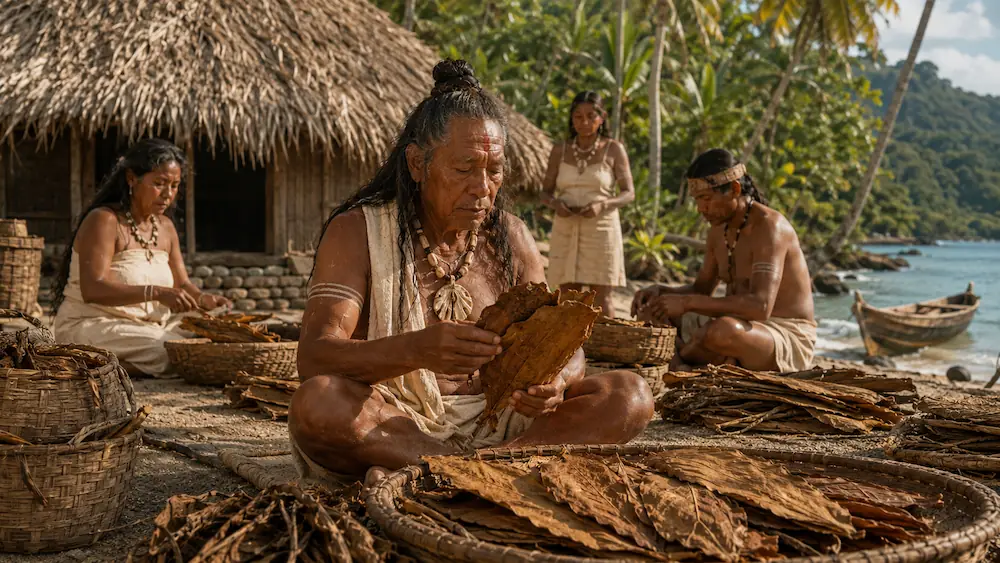
The proto-cigar of Mesoamerica was a rougher thing than anything you have seen in a humidor. Dried tobacco leaves were gathered into a bundle, bound with strips of palm leaf, corn husk, or plant fiber, and lit at one end. Some cultures used hollow reeds packed with loose tobacco, functioning more like a rudimentary pipe than a wrapped leaf. Others rolled leaves tightly and bound them with bark cord. The form varied by region and tribe, but the intent was consistent: a sustained burn, a directed draw, and smoke produced on purpose and with intention.
What all these forms shared was the relationship between the maker and the plant. Tobacco was cultivated, harvested, dried, and prepared with knowledge passed down across generations. The Taino people of the Caribbean had been doing exactly this for at least 2,000 years before Columbus arrived.
What all proto-cigars shared: intentionality, every smoke had a purpose, ritual or diplomatic, none were casual; craft passed down through generations, tobacco was cultivated, harvested, dried, and prepared with inherited knowledge; the relationship between maker and plant, this was not a commodity, it was a living part of the culture; and consistency of purpose across varied forms, reed, bundle, or rolled leaf, the goal was always the same: sustained, directed smoke.
The Taino, Cohoba, and the birth of the word "cigar"
The Taino were Arawak-speaking people who inhabited Cuba, Hispaniola, Puerto Rico, and the Caribbean island chain stretching southeast to Aruba. They held inter-island gatherings of chiefs and community leaders called Sik'ar, organized around trade, diplomacy, law, and ceremony. At a Sik'ar, tobacco was the centerpiece. Chiefs traded their regional leaf varieties, reviewed treaties, settled land disputes, and conducted the business of governing a civilization spread across hundreds of miles of open ocean.
At the heart of Taino spiritual life was the Rite of Cohoba. The Behique, the tribe's shaman and healer, would take his seat on the Duho, his ceremonial throne, and begin the ritual. He smoked Cohoba, a prepared form of tobacco, sometimes combined with other plants, until he entered a trance state. In that state, he was believed to cross into Coabey, the Taino spirit world, to communicate directly with ancestors and deities. Sacred carved objects called Cuey surrounded the ceremony. The decisions that came out of a Cohoba ritual were binding. Tobacco was not incidental to Taino life. It was the governing instrument of their society.
The Spanish declared the Taino extinct around 1565. They were wrong. A 2001 genetic study at the University of Puerto Rico found that more than seventy percent of the island's population carries mitochondrial DNA traced directly back to Taino Arawak ancestors. Their descendants are still here, and so is their leaf.
The Taino word for the rolled tobacco leaf was tobak, the direct root of the word "tobacco" in English, Spanish, French, and virtually every language that adopted it after European contact. When the Spanish encountered the Sik'ar ceremony and heard the word spoken aloud, they adapted it into cigarro. The French took it as cigarette. The word we use today, cigar, traces directly to a Taino gathering on a Caribbean island, centuries before any European had laid eyes on this part of the world.
Several other names from that world are still carried in the cigar industry today. Cohiba, the Taino name for their rolled leaves, became one of the most recognized Cuban cigar brands in history. Cuaba is another Taino name preserved in the modern cigar world. Even the name Cuba is believed by many historians to derive from the Taino word cubao, meaning "where fertile land is abundant."
What Columbus was about to walk into
By the time Christopher Columbus made landfall in 1492, he was sailing into a tobacco culture that had been perfecting itself for longer than most civilizations have existed. The Taino people of Cuba and Hispaniola were growing, curing, rolling, and smoking with a level of sophistication that would take European observers years to fully appreciate. Columbus did not discover tobacco. He stumbled into it, and the world was never the same afterward.
Before Havana. Before Cuba. Before Columbus. The cigar was already sacred, already sophisticated, already civilization-shaping. Every handmade smoke you light today is the living end of a 12,000-year-old story. Part 2 picks up where Columbus landed, and nothing was ever simple after that.
Glossary
Frequently asked questions