
- After 1492, tobacco spread from the Caribbean across Europe and reached China, India, and Japan within a century, governments immediately moved to tax and control it.
- In 1676, the cigar as we know it, filler, binder, wrapper, was invented in Seville by skilled female workers called cigarreras; that construction format has not changed since.
- Cuba's cigar production was effectively illegal from 1717 to 1817 under Spanish royal monopoly; eleven months of British occupation in 1762 quietly introduced Havana tobacco to the entire world anyway.
I have been smoking long enough to know that the moment you start digging into cigar history, you cannot stop at Columbus. That first encounter in 1492 was not an ending, it was a fuse being lit. What came next was a scramble that would span continents and centuries, involving kings, conquistadors, tax collectors, and thousands of women in a Seville factory whose hands would define what we now hold between our fingers. Governments have always understood one thing about tobacco: wherever it goes, money follows. And wherever money follows, they find a way to get their hands on it. That part of the story has not changed in five hundred years.
The leaf moves fast
The Spanish did not waste time. By 1518, Hernán Cortés, having already planted his flag across Mexico, encountered tobacco among the Aztec and sent seeds back to King Charles V of Spain. It was not the first time tobacco had reached European ears, but it was one of the first formal introductions of the plant itself to the Spanish crown. By 1520, Spanish settlers in Cuba were already growing tobacco for personal use. That is how quickly this thing moved, less than thirty years after Columbus first watched a Taino elder exhale a long pull of smoke into the Caribbean air, Europeans were growing the plant themselves.
Around 1542, Spain quietly established the first cigar-making workshop in Cuba. It was a small operation, tightly controlled, and existed largely to supply the ruling class and the clergy on the island. The broader population was still expected to roll their own. But the workshop mattered, it was the first time a structured, commercial tobacco operation existed on Cuban soil, and it planted a seed that would take nearly three centuries to fully flower.
In 1560, a French diplomat named Jean Nicot, France's ambassador to Portugal, became so enthusiastic about tobacco's supposed medicinal properties that he began sending it to members of the French court, including Queen Catherine de' Medici, who reportedly used it to treat her migraines. Nicot was so relentless in promoting the plant that when scientists later isolated its primary chemical compound, they named it after him. Nicotine. Not exactly the legacy most diplomats aim for, but a permanent one.
The spread did not stop at Spain or France. Across the 1500s, tobacco moved through Europe in the forms most Europeans first recognized it, snuff for the nose and loose leaf for the pipe. It traveled along trade routes the same way spice and silk did, carried by merchants, sailors, and diplomats. By 1602, pipe smoking had reached well beyond the European continent into China, India, and Japan. A plant that had been sacred and ceremonial in the Americas for thousands of years had become a global commodity in under a century.
By the late 1590s, tobacco was rare and expensive enough in England that the best Spanish leaf was selling for the equivalent of $125 a pound in today's money. Londoners were spending £320,000 a year on tobacco, £120,000 of which was still flowing back into Spanish hands. England had a problem. It needed its own source. That problem would soon have an answer.
In 1612, an English settler in Jamestown, Virginia, made a decision that would reshape the economic history of North America. John Rolfe, the same man who would marry the Powhatan chief's daughter, Pocahontas, obtained tobacco seeds from somewhere in the Caribbean, likely Trinidad, and planted them at his farm on the banks of the James River. The native tobacco growing in Virginia was too harsh and bitter for European tastes. Rolfe's Caribbean seeds produced a leaf that was fragrant, smooth, and noticeably sweet, and England loved it. By 1617, the Virginia Colony shipped its first commercial tobacco to England. Two years later, exports had more than doubled. Twelve years after that, one and a half million pounds were crossing the Atlantic annually.
When the tax men arrived
Here is where the story starts to feel very familiar. The moment tobacco became a global commodity, governments looked at it the way they always look at something people cannot stop consuming, as a source of income that essentially collects itself.
In 1629, Cardinal Richelieu of France levied the first formal tobacco tax, thirty sols per pound. He also banned over-the-counter tobacco sales and restricted distribution to pharmacists, who could only dispense it by prescription. Whether that framing was about public health or control of supply is a question history has answered pretty clearly. France would later go further, at various points in the 1600s, growing tobacco was prohibited throughout the country entirely, with capital punishment on the table for serious offenders. The tax trend spread through Europe like the smoke itself, unstoppable and everywhere at once.
Spain had its own version of this, and it was more aggressive than most. There is a story, and it is a good one, about how tobacco transported across the Atlantic was packed into rum barrels for the voyage. Rum already carried a tax. The Spanish government's position was straightforward: if it arrived in an alcohol barrel, it was taxable as alcohol.
Tobacco transported across the Atlantic was packed into rum barrels for the voyage. Rum carried an alcohol tax. The Spanish government's position was straightforward: if it arrived in an alcohol barrel, it was taxable as alcohol. The category became known informally as smoking alcohol, tobacco taxed under the same framework as liquor simply because of how it was shipped. It is the kind of bureaucratic logic that sounds absurd until you realize governments are still using versions of it today.
By 1636, Spain had formalized its domestic tobacco operation, the estanco, giving the crown control over production, manufacture, and retail. At its peak, tobacco revenues accounted for nearly one third of total domestic public income in Spain, second only to silver and gold flowing from the Americas. The Spanish crown also issued royal decrees mandating that Cuban tobacco could only be sold directly to Spain, with direct sales to foreign powers punishable by death. The edict created, as one historian noted, a remarkable job opportunity for smugglers that lasted the better part of two centuries.
The cigar is born in Seville
All of this trade, taxation, and European appetite for tobacco eventually led to something nobody expected to happen in Spain. In 1676, in the city of Seville, the cigar as we know it today was born.
Seville was already the commercial heart of Spain's tobacco empire, the place where Cuban leaf arrived, was processed, and was shipped throughout Europe. The Royal Manufacturers of Seville had grown into an enormous operation. By the mid-1700s, the Seville cigar factory had become the largest industrial complex in the world at the time, a walled city with its own chapel, its own rules, and its own prison, housing more than 4,000 workers during the day and rolling 100,000 cigars daily.
It was in those Seville factories that someone figured out a better way to enjoy the leaf than packing it into a pipe or grinding it for snuff. They began rolling it, filler leaves at the center, a binder leaf wrapped around to hold the shape, and a fine outer wrapper leaf to finish it. Three components. One cigar. The construction format that came out of Seville in 1676 is the same one that every premium handmade cigar in the world is still built on today.
The women who did most of this rolling were called cigarreras. They were the backbone of the Seville factories, skilled, fast, and largely responsible for the quality that made Spanish-rolled cigars the standard. The cigarrera became a cultural figure in her own right, romanticized in art and literature, most famously as the inspiration for the character Carmen in Bizét's 1875 opera, set, not coincidentally, in a Seville tobacco factory. Catherine the Great of Russia was reportedly such an enthusiastic cigar smoker that she had her cigars wrapped in silk ribbons to protect her regal fingers from the tobacco leaf, an early and decidedly imperial precursor to the cigar band.
What the Taino left behind
While Seville was defining the construction of the cigar, something equally important was already happening in Cuba and had been for centuries. The Taino people who first grew and rolled tobacco on the island had developed fermentation and aging techniques that the Spanish settlers adopted and eventually industrialized. The pilon, a large stack of tobacco leaves packed together and left to ferment under their own heat, was a method the Taino used to develop and deepen the flavor of their leaf. Palm bark was used to wrap and age cut tobacco, protecting it while allowing it to breathe and mellow.
These are not historical curiosities. They are still the foundational methods of premium cigar production today. Every aged, fermented leaf in your humidor has a lineage that runs directly back to indigenous hands on a Caribbean island.
Taino techniques still in use today: the pilón, stacking harvested leaves to ferment under their own heat, developing flavor and breaking down harsh compounds; palm bark aging, wrapping cut tobacco to protect and mellow it while allowing the leaf to breathe; intentional fermentation, controlled processing of the leaf before rolling, not simply drying; and Vuelta Abajo cultivation knowledge, regional growing expertise passed down through generations of Cuban farmers.
King Philip V pulls the lever
In 1717, King Philip V of Spain made a decision that would define, and delay, Cuban cigar history for exactly one hundred years. He established a formal royal monopoly, the Real Factoría, over all tobacco cultivation in Cuba. Under this system, every tobacco leaf grown on the island was the property of the Spanish crown. Cuban farmers grew it, harvested it, and handed it over. The Spanish government then processed it, mostly in Seville, and sold it throughout Europe. Cuba supplied the raw material. Spain collected the money. Cigar production in Cuba itself was not just controlled, it was, for practical purposes, illegal.
The Cuban tobacco farmers, the vegueros, did not accept this quietly. In 1717, the same year the monopoly was established, tobacco farmers in the Havana region staged a full rebellion, marching on the city in protest. Spain crushed it. Uprisings followed again in 1720 and 1723. In 1723, twelve rebel leaders were hanged. The monopoly held, but the resentment it generated never went away, and the contraband trade that grew alongside it proved impossible to fully suppress. By the end of the eighteenth century, estimates placed fifty percent of the tobacco in Spain itself as smuggled product.
From 1740 to 1760, approximately eighty-five percent of the tobacco processed in Seville's royal factory came from Cuban fields. Annual revenues grew from nearly four million pesos in the early 1740s to over five million by the late 1750s, eventually exceeding the revenues from silver. Cuba was feeding one of the most profitable industries in the world and seeing almost none of the return.
Eleven months that changed everything
In 1762, during the Seven Years War, British forces captured Havana. The occupation lasted only eleven months, but in that brief window something extraordinary happened. The British opened Cuban ports to free trade for the first time in the island's history. More international shipping moved through Havana in those eleven months than in the previous two and a half centuries of Spanish control. Cuban cigars, the Habanos that had been effectively locked away from the world, suddenly reached England, Germany, North America, and beyond.
When the British left under the Treaty of Paris in 1763, they took something with them that could never be given back: the world now knew what Cuban tobacco tasted like. Lt. Col. Israel Putnam, a British officer who would later become one of the heroes of the American Revolution, returned from the Havana occupation with three donkeys loaded with Cuban cigars and what is believed to have been Connecticut Valley-bound tobacco seed. The great Connecticut shade tobacco that lines so many premium cigars today owes at least part of its origin to that journey.
Spain got Cuba back under the Treaty of Paris in 1763, but it had learned an uncomfortable lesson, once a pleasure is known to the world, it is very difficult to hide or control. The contraband trade in Cuban cigars that followed was, by most accounts, impossible to fully suppress.
By 1797, a man named Francisco Cabañas had established the first private Cuban cigar brand to officially compete with the Spanish state monopoly, an operation that would remain in business until Castro nationalized the industry in 1962.
1817: the door opens
In 1812, a Cuban reformer named Don Francisco de Arango y Parreño formally demanded the dissolution of the tobacco monopoly, arguing that only free trade could develop the island's full agricultural potential. His argument landed. On January 1, 1817, King Ferdinand VII of Spain signed a royal decree making the production and sale of tobacco a legal endeavor in Cuba. One hundred years of monopoly, suppression, and enforced raw-material supply was over.
The effect was immediate and stunning. The small family workshops called chinchales, which had been operating quietly and illegally throughout the monopoly years, came out of the shadows. Entrepreneurs arrived. Factories opened. In 1840, there were 306 registered cigar factories operating in Havana. By 1855, Cuba was exporting 356.5 million cigars annually.
In 1833, phosphorus friction matches were introduced commercially in England, making the act of lighting a cigar significantly more convenient than it had ever been. In 1827, the lifting of remaining taxes on cigar production by Spain's Superintendent of Finances accelerated the boom further. Cigar smoking was catching on in New England and major North American port cities. The appetite was there, and the supply was finally free to meet it.
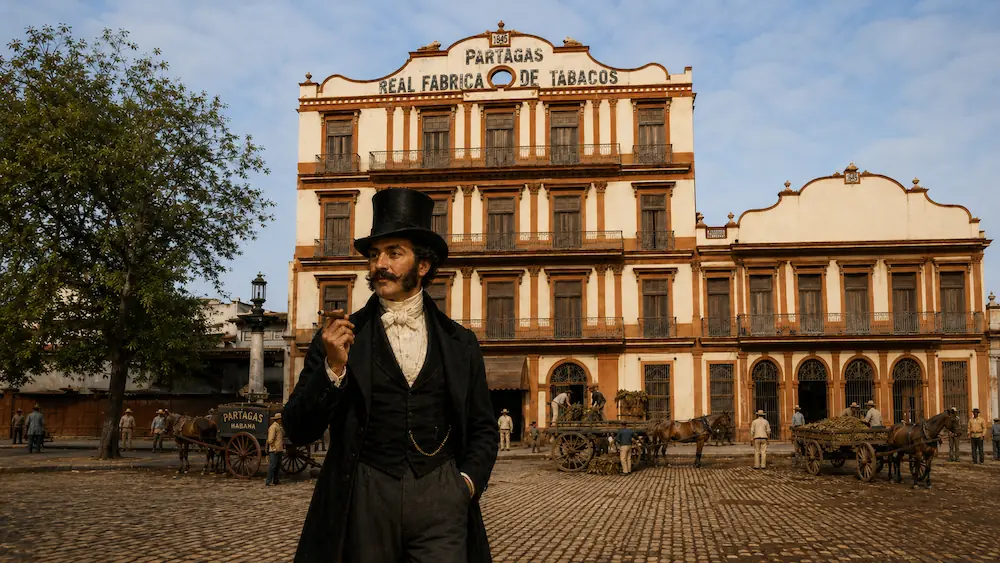
A young Catalan immigrant named Jaime Partagás had arrived in Cuba around this time. He was not content simply to ride the boom, he spent years buying up the finest tobacco plantations in the Vuelta Abajo region of Pinar del Río, the soil widely considered to be the greatest tobacco-growing land on the planet. By 1845, he opened his factory on Industria Street in Old Havana. The building still stands. The Partagás name became one of the most respected in the cigar world, and that address in Old Havana became a physical anchor point for what was about to become the golden age of the Cuban cigar.
From Columbus stumbling into a Taino ceremony in 1492 to 306 cigar factories operating legally in Havana by 1840, the story of the cigar is a story of governments trying to own something that belongs to everyone. They never fully managed it. The golden age that followed is the story of Part 3.
Glossary
Frequently asked questions